
Everyone knows Google dominates search, but the scale is still worth pausing on. As of early 2026, Google holds roughly 90% of the global search market across all devices — and on mobile it's even more lopsided, sitting north of 95%. That said, the ground is shifting, and the SEO playbook is shifting with it.
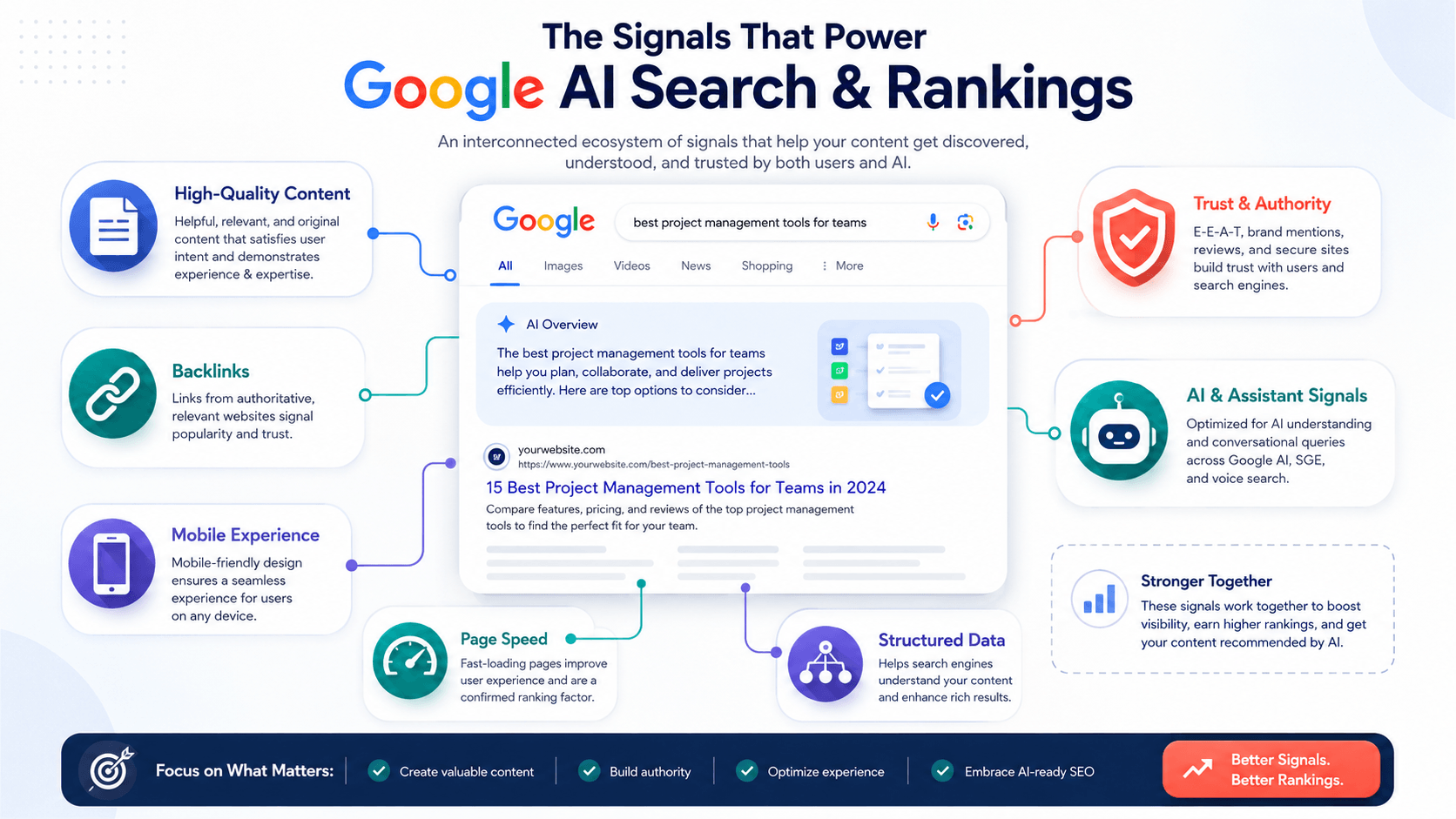
Bing, the nearest competitor, holds a single-digit share globally. But Google's share has slipped from about 91% to roughly 89–90% over the past few years — the most meaningful erosion in over a decade. The cause isn't a rival search engine; it's the rise of AI-powered answers, both inside Google's own results (AI Overviews) and on platforms like ChatGPT, Gemini, and Perplexity. We'll come back to what that means for you, because it changes the SEO playbook in 2026.
For now, the takeaway is simple: Google is still where the overwhelming majority of organic discovery happens. Ranking well there remains the single highest-leverage thing most websites can do. But the competition is fierce, and Google's algorithm leans on a large set of ranking signals to decide who shows up first.
1 What Are Google Ranking Factors?
Ranking factors are the signals a search engine's algorithm uses to decide where a page appears in the results. When you type a query into Google, the algorithm weighs hundreds of these signals to surface the pages it judges most useful and relevant.
SEO (Search Engine Optimization) is the practice of meeting those criteria. If ranking factors are the standards Google sets, SEO is how you reach them — improving a page so the algorithm sees it as worthy of a high position.
A Quick Clarification
The often-quoted figure of "200 ranking factors" is an SEO-industry estimate, not an official number. Some signals carry far more weight than others, and you don't need to chase every one. Below are the ones that consistently move rankings in 2026.
2 High-Quality, Helpful Content
Ask yourself why you use Google. The answer is usually that it returns the most relevant, trustworthy results. Google guards that reputation aggressively, which is why content quality sits at the center of everything.
In March 2024, Google folded its "Helpful Content System" directly into its core ranking systems. The message was blunt: content should be made for people first, not search engines. Pages that exist mainly to rank — thin, derivative, or AI-spun filler — are exactly what Google's recent core updates have been demoting. The December 2025 and early-2026 core updates hit sites with shallow content, missing authorship, and weak sourcing especially hard.
Copying or lightly rewording an existing article gives Google no reason to prefer your page. You need information gain — something genuinely useful that isn't already everywhere. Add original analysis, real examples, data, or first-hand insight.
Quality isn't only about substance. Tone, structure, and clarity determine whether a reader stays. Write for the person, use clear headings, break up walls of text, and keep the language natural.
3 E-E-A-T: Experience, Expertise, Authoritativeness, Trustworthiness
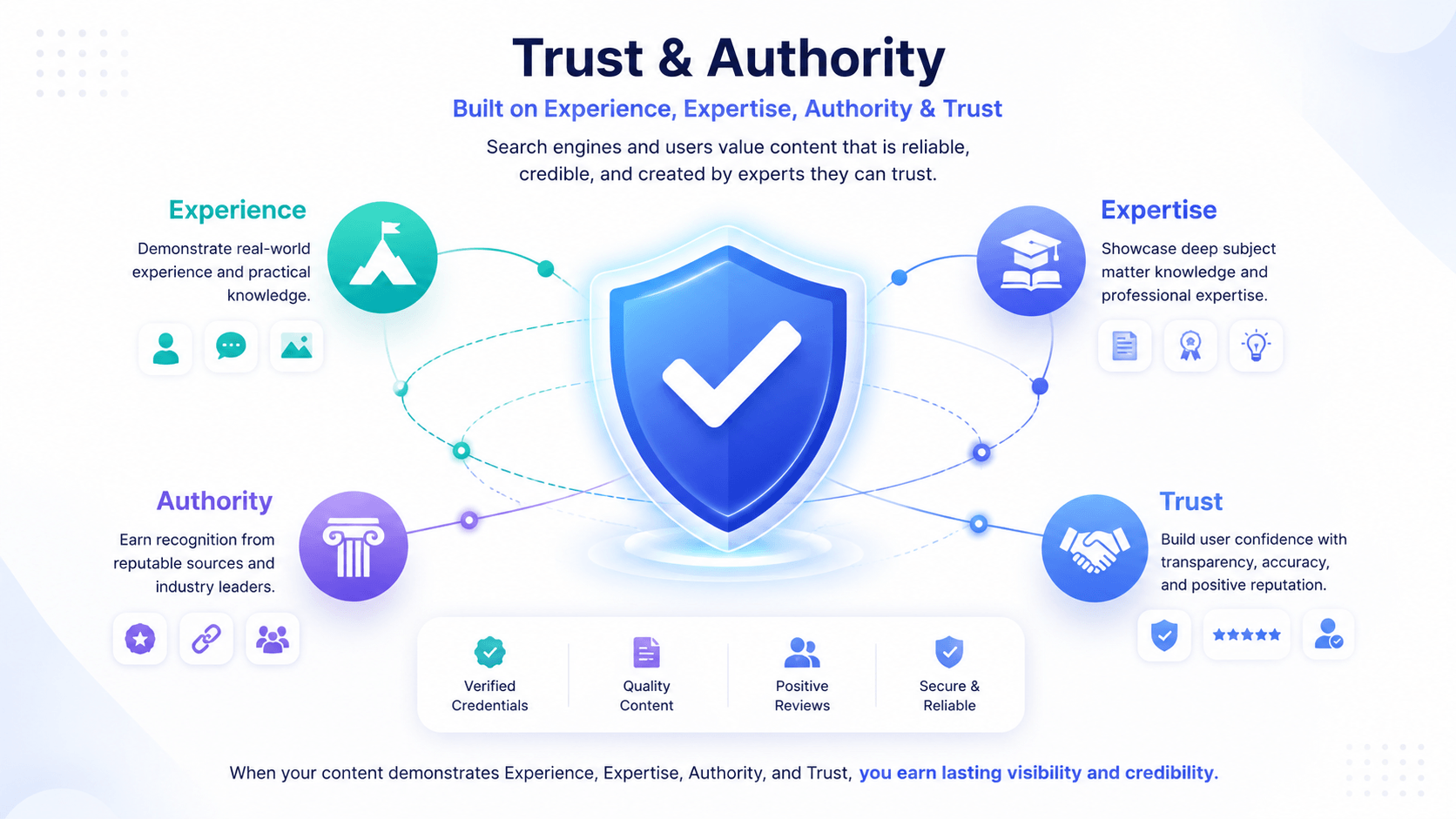
E-E-A-T is one of the most misunderstood concepts in SEO, so let's be precise. It is not a direct ranking factor. It's a framework from Google's Search Quality Rater Guidelines that human raters use to assess content quality — and their evaluations help Google train and refine the algorithms that do rank pages.
The acronym started as E-A-T in 2014. Google added the second "E" — Experience — in 2023 to reward first-hand knowledge: content from someone who has actually used the product, visited the place, or lived through the situation.
The Four Components
- Experience — You've actually done it. First-hand knowledge, not aggregated research.
- Expertise — You have demonstrable knowledge or skill in the subject area.
- Authoritativeness — Others recognize you as a credible source in your niche.
- Trustworthiness — Your content is accurate, transparent, and safe. Google says this is the most important of the four.
E-E-A-T matters most for YMYL ("Your Money or Your Life") topics — health, finance, legal — where bad information can genuinely harm people. Practical ways to strengthen it: publish real author bios with credentials, cite reputable sources, keep information accurate and updated, secure your site with HTTPS, and make contact and ownership information transparent.
4 Backlinks: Still a Backbone, But Quality Over Quantity
Years ago, you could spam inbound links and muscle your way onto page one. Those days are gone. Google has spent years refining its algorithm to catch manipulative link-building, and buying links can get a site demoted or penalized outright.
Even so, backlinks remain one of the strongest off-page signals. They build the authority of both individual pages and your domain as a whole. Look at Wikipedia: it earns vast numbers of organic links from major sites, and that accumulated authority is a big reason its pages rank so consistently.
A handful of links from authoritative, topically relevant sites will do more for you than hundreds of low-quality ones. Earn links by being genuinely link-worthy — original research, useful tools, and standout content — rather than chasing quantity.
5 Core Web Vitals and Page Experience
Google has emphasized page experience for years, and the technical health of your site still plays a role — particularly as a tiebreaker when competing pages are otherwise similar in quality.
Important 2024 Update
Google retired FID (First Input Delay) and replaced it with INP (Interaction to Next Paint) on March 12, 2024. If you see SEO content still listing FID as a Core Web Vital, it's out of date.
How long until the largest visible element renders. Target: under 2.5 seconds. Improve by optimizing images, using a CDN, and reducing render-blocking resources.
How quickly the page responds across all interactions during a visit. Target: under 200ms. INP is stricter than the old FID — it measures the full response cycle, not just the initial delay.
Whether elements jump around unexpectedly while loading. Target: under 0.1. Fix by reserving space for images, ads, and embeds so layout doesn't shift as the page renders.
Google measures these at the 75th percentile of real users — meaning at least 75% of your visitors need a "good" score. Roughly half of all sites currently fail. Check yours in Google Search Console or PageSpeed Insights.
6 Mobile-Friendliness
Mobile now accounts for the majority of searches worldwide, and Google completed its move to mobile-first indexing — meaning it primarily uses the mobile version of your site to evaluate and rank it.
If your site isn't built to work cleanly on a phone, you're not just frustrating users — you're handing Google a poor version of your site to judge. Responsive design, readable text without zooming, tappable buttons, and fast mobile load times are no longer optional. If it isn't mobile-friendly, it isn't going up.
7 Keyword Optimization (the 2026 Way)
Keyword stuffing is long obsolete and now actively hurts you. Today, keywords matter, but only when placed naturally and in service of clarity. The goal is to signal relevance to both readers and the algorithm without ever sounding forced.
Lead with your primary keyword where it reads naturally. It tells users and Google what the page is about at a glance — the single most important on-page placement.
Cover the concepts and synonyms surrounding your topic. People phrase searches differently, and Google's language understanding rewards comprehensive coverage.
Short descriptive URLs, keyword-relevant H2/H3 headings, and descriptive image alt text all help Google (and accessibility tools) understand your content.
Work primary and related terms in naturally, including in the intro and conclusion. Context and coverage matter more than any target keyword density.
8 On-Page Experience and Engagement Signals
Google has said it does not use raw bounce rate or time-on-page from analytics as direct ranking factors. They're useful diagnostics for you, and they correlate with the user satisfaction Google does care about — so they're worth optimizing for.
9 Search Intent and Topical Authority
Before you can rank, you have to understand search intent — what the user is actually trying to accomplish. Are they trying to learn something, compare options, or buy? Matching your content format to that intent is critical. For a "how to" query, a video or step-by-step guide often outperforms a dense article. Mismatch the intent and even a well-optimized page will struggle.
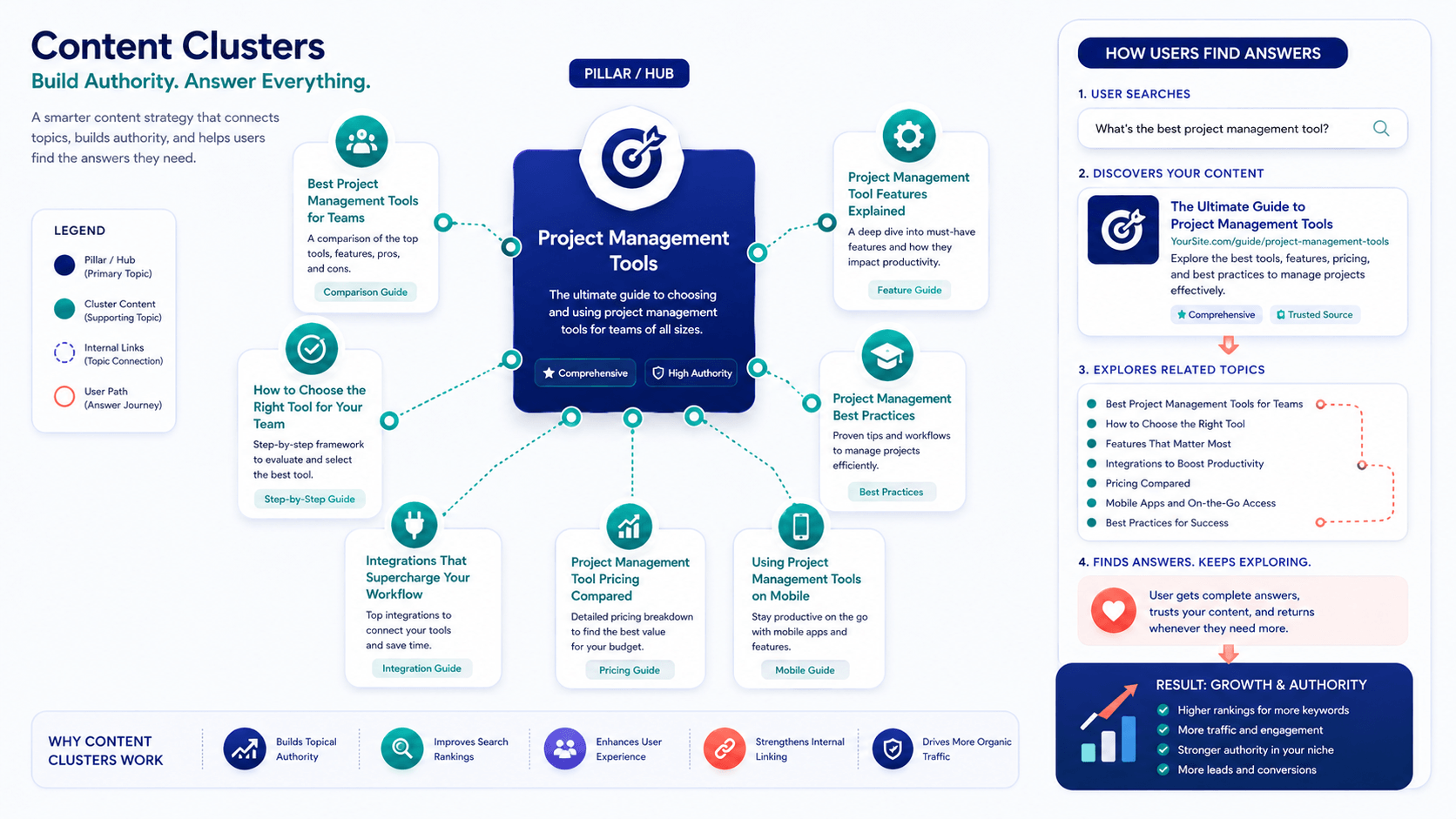
The bigger strategic play is topical authority: covering a subject comprehensively rather than publishing one isolated post. If you write about "Disney World planning," you should also cover restaurants, the best times to visit, budgeting, ride strategies, and so on. Clustering related content around a core topic signals genuine expertise to Google and keeps users on your site longer.
10 Structured Data and Schema Markup
Schema markup is code you add to your pages that helps search engines understand and categorize your content — a translation layer that spells out, in a language Google reads cleanly, what a page is about: a recipe, a product, an event, an FAQ, a review.
It isn't a direct ranking factor on its own, but it makes your pages eligible for rich results — star ratings, FAQ dropdowns, recipe cards, pricing panels — which can dramatically improve how your listing looks and how often it gets clicked. In an era of AI Overviews, well-structured data also helps your content be understood and cited by AI systems.
11 Content Length and Depth
You'll hear "keep it short and concise" and "long content wins" with equal confidence. The truth is nuanced: length is not a ranking factor — depth is. Longer pieces often rank well because thorough coverage tends to require more words, earns more links, and gets shared more. But padding a post with filler to hit a word count backfires.
The right instruction isn't "write 2,000 words." It's "cover the topic completely, and use exactly as many words as that takes." If the subject genuinely warrants depth, go long. If it doesn't, don't.
12 Social Signals and Internal Linking
Social signals — shares, mentions, and engagement — are not confirmed direct ranking factors, and Google has been skeptical of them. But they're far from useless: social distribution drives traffic, earns visibility that leads to links, and builds the brand recognition that underpins authority. Treat social as an amplifier, not a ranking lever.
Internal linking is underrated and entirely within your control. Linking between your own related pages helps Google discover and understand your content, distributes authority across your site, and keeps users moving through your topic clusters instead of bouncing back to search. It's one of the easiest high-impact improvements most sites overlook.
13 The 2026 Game-Changer: AI Overviews and Generative Search
Here's the factor most ranking-factor articles haven't caught up to — and the one your competitors are probably ignoring.
Google now shows AI Overviews on a large and growing share of queries — somewhere around 13–14% of all U.S. searches and roughly 30%+ of informational queries, with numbers climbing steadily through 2025 and 2026. This is reshaping click behavior in ways that make some classic SEO advice obsolete.
This has given rise to GEO (Generative Engine Optimization) — optimizing not just to rank, but to be cited by AI answers. The good news is that GEO overlaps heavily with everything above: clean structured data, genuine E-E-A-T, clear and factual writing, and authoritative sourcing are exactly what gets content pulled into AI answers. The new dimensions are citation-friendly phrasing, being mentioned across the broader web, and writing content that directly and clearly answers specific questions.
The Strategic Shift for 2026
- Stop optimizing only for the blue link. Optimize to be the answer.
- Structure your content so AI systems can extract and cite clear, factual statements.
- Build genuine E-E-A-T — the AI cites sources it trusts, not just sources that rank.
- Use schema markup so your content is machine-readable and citation-friendly.
14 The Takeaway: Focus Where It Counts
Google uses a large number of ranking signals, but they don't carry equal weight. If you want visible, durable growth, concentrate your effort here:
- Create genuinely helpful, original content — this is the foundation everything else rests on.
- Build real E-E-A-T, especially trust, especially on YMYL topics.
- Earn relevant, authoritative backlinks — quality over quantity.
- Nail the technical basics — mobile-first, fast, and passing Core Web Vitals (LCP, INP, CLS).
- Match search intent and build topical authority across your niche.
- Adapt for AI search — structure your content to be understood and cited, not just ranked.
None of this happens overnight. Real SEO results take months of consistent, informed work — and the landscape keeps moving, faster now than ever. But the sites that win are the ones that stop chasing algorithm tricks and start genuinely being the best, most trustworthy answer to what their audience is searching for.
That's the whole game. Everything else is detail.