
This is the first post in an open growth log. As the site grows, I'll keep publishing the real numbers from my micro-SaaS — what's working, what isn't, and the reasoning behind the decisions I'm making. I'm not putting it on a fixed schedule; I'd rather post when there's something genuinely worth sharing than pad out a calendar. No vanity metrics, no rounding up, and I'll be just as specific about the mistakes as the wins. If that's your kind of thing, follow along.
1 The Starting Point
I bought the domain in December 2025 but didn't start publishing until the end of February 2026. So at the time of writing I'm roughly three and a half months into actually having content live.
I started from nothing: no audience, no email list, and — this part matters for the rest of the post — no backlinks. Not a single one. Everything below happened on the back of content and site structure alone.
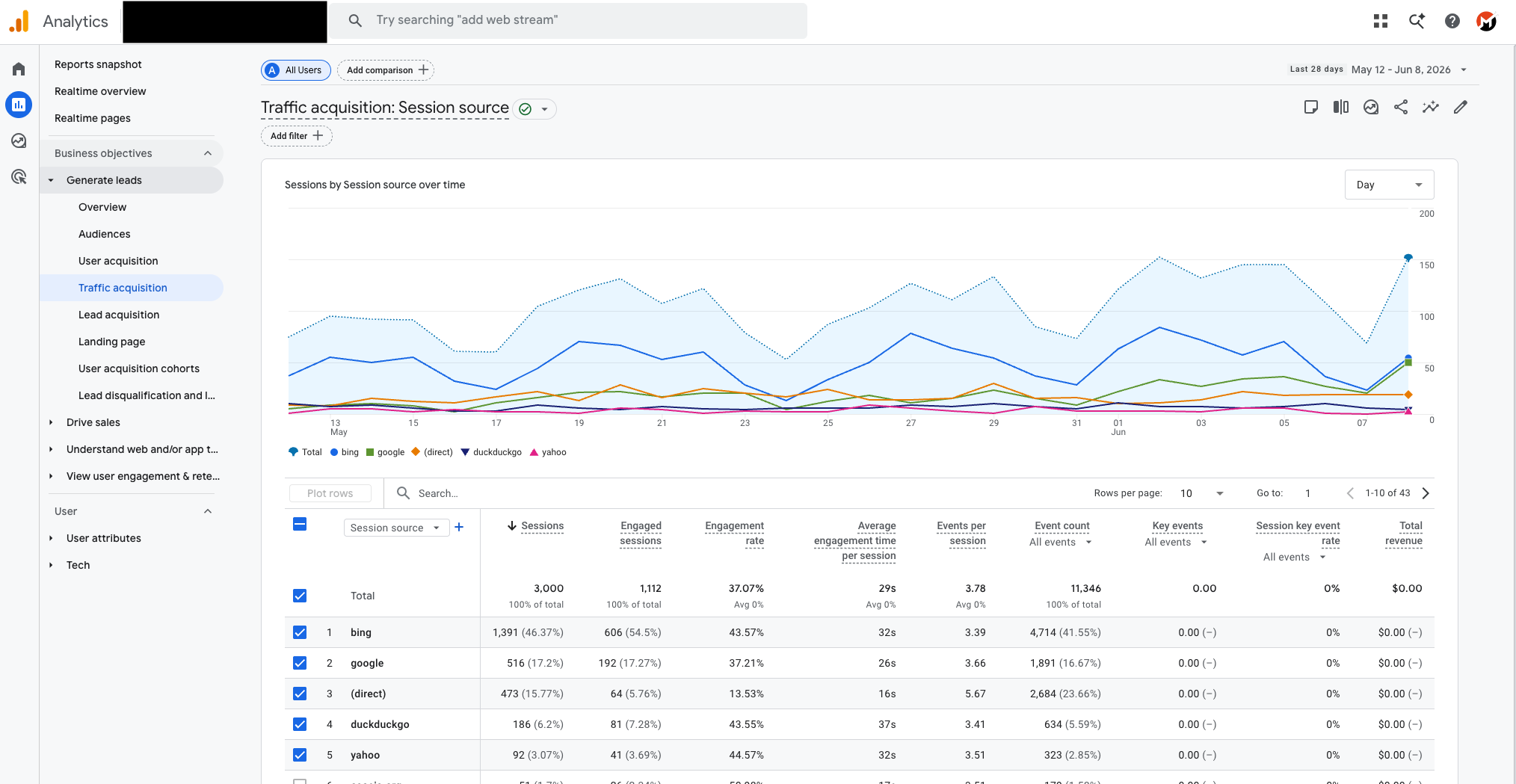
In those few months the site has pulled in about 79,000 impressions and 553 clicks on Google, and just under 3,000 sessions across all sources. For a brand-new site in a focused niche, I'm happy with that trajectory. But the most interesting thing I've learned has nothing to do with the totals.
2 Bing Beats Google 3-to-1
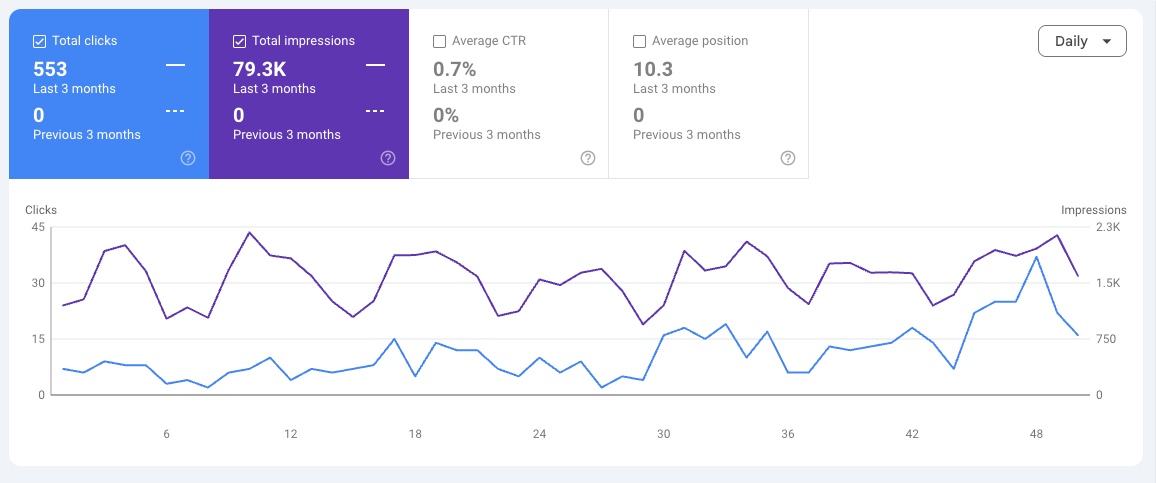
Here's the source breakdown from the last month, by sessions:
Bing alone sends nearly three times what Google does. But it's actually more lopsided than that, because DuckDuckGo and Yahoo both pull their search results from Bing's index. If you group the Bing-powered engines together, you get roughly 1,669 sessions — about 56% of all traffic. Google sits at 17%.
Bing has far less SEO competition, it tends to index and rank newer sites faster, and it gets steady default traffic through Microsoft Edge. For a niche like mine, that combination seems to add up to an outsized share.
The real lesson here isn't "Bing is great." It's this: Google Search Console only reports Google. If GSC is the only place you look — and for most people it is — you can be completely blind to your single biggest channel. I almost was. The only reason I caught it is that I checked my analytics by source rather than trusting one dashboard.
Two Practical Takeaways if You're Early-Stage
- Look at your traffic by source in GA4, not just GSC. The story can be very different.
- Set up Bing Webmaster Tools. If Bing is doing this much work for you, it's worth watching directly.
One more thing worth noting: the search sources engage at similar, healthy rates — Bing at 43.6%, DuckDuckGo at 43.6%, Yahoo at 44.6%. Direct traffic is the outlier, engaging at just 13.5% with a 16-second average session. I'm not reading too much into the direct number yet — it could be returning users, bots, or untagged links — but it's on my list to investigate.
3 How a Site With Zero Backlinks Got Here
This is the part I'm proudest of, because the conventional wisdom says it shouldn't work.
Most SEO advice treats backlinks as the price of entry: build links or don't bother ranking. I haven't built a single one yet. Everything so far has come from two things — a deliberate topical map and strong internal linking.
Instead of picking keywords at random, I laid out the full set of subjects my niche covers and grouped them into clusters — a handful of broad pillar themes, each surrounded by the more specific questions and subtopics that feed into it. That map became my content plan.
Each pillar topic anchors a group of related articles. I've now published 20-plus posts, and almost none of them stand alone — each one belongs to a cluster and exists partly to reinforce the others.
Every post links to its pillar and to its siblings. This does two things: it helps readers go deeper, and it passes ranking signals around the cluster so the whole group gains authority together rather than each page fighting alone.
The result is that, with no external links at all, the site has earned enough topical authority in its niche to surface across all those search engines. If you're starting fresh in a niche that isn't brutally competitive, topical depth plus internal linking can get you further than you'd expect before you ever touch outreach. Links will amplify this — they're next on my list — but they weren't the foundation.
4 More Clicks Without Ranking Higher
Here's the data point that genuinely changed how I think about SEO. Comparing the last 28 days to the previous 28 days in Search Console:
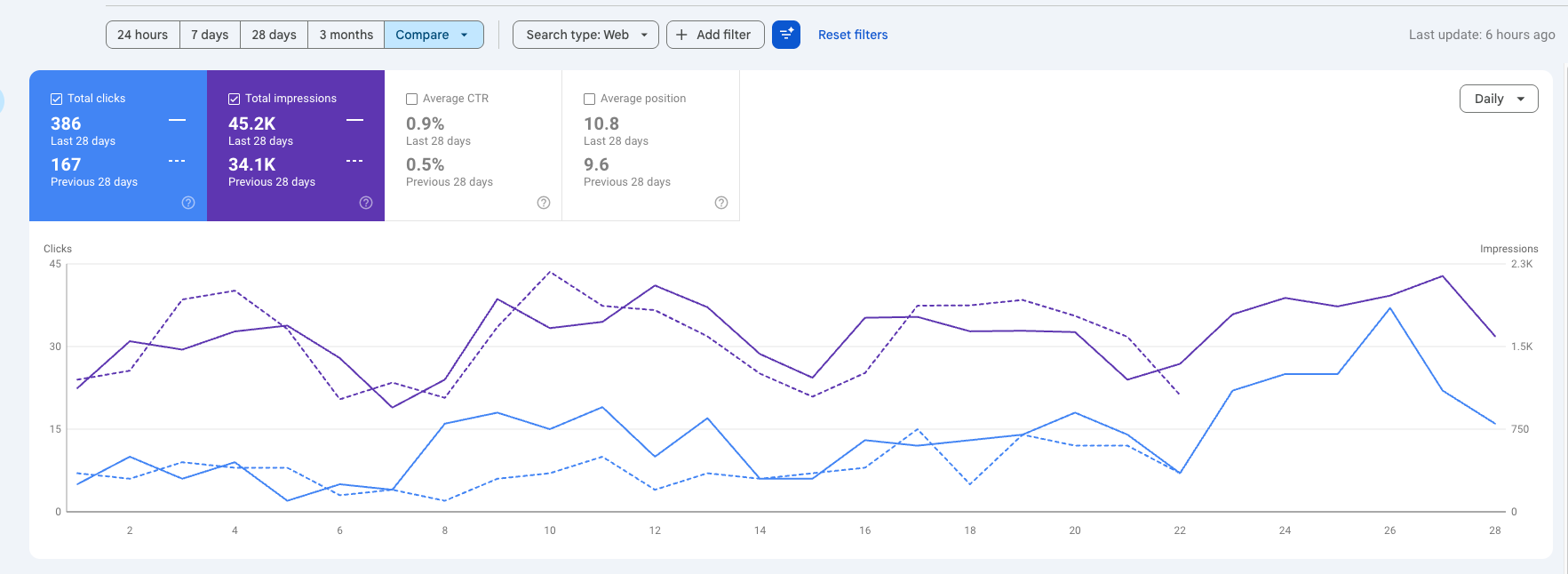
Read that again. My clicks more than doubled — while my average position got worse, slipping about 1.2 spots. Everyone's mental model is "rank higher, get more clicks." But my rankings drifted down and my traffic still doubled.
What did the work was CTR. It nearly doubled, from 0.5% to 0.9%. More people clicked the same (or slightly lower) listings.
I can't prove exactly why, but the timing points to one likely contributor: in May I spent time fixing technical SEO issues and cutting the site's page load speed. It's plausible that better-structured, faster pages — along with sharper titles and descriptions — made my listings more clickable and the experience better once people arrived. I'm framing that as a likely factor, not a proven cause, because I changed several things at once.
The takeaway: chasing raw ranking position isn't the only lever, and it might not even be the best one. How clickable your listing is — and how fast and clean the page is when people land — can move traffic more than climbing a spot or two.
5 What I Got Wrong
If I only told you the wins, this wouldn't be honest. Here's the unflattering side.
An average position of 10.8 means I'm mostly sitting at the bottom of page one or the top of page two. There's a lot of traffic I'm leaving on the table simply by not ranking higher.
Yes, it nearly doubled — to 0.9%. That's still under one percent. There's plenty of room to write better titles and descriptions.
13.5% engagement and 16 seconds a session is poor, and I don't fully understand it yet.
I haven't set up conversion tracking. My analytics shows zero revenue and zero key events — not because nothing's happening, but because I'm not measuring it. Right now I can tell you about traffic and nothing about outcomes.
6 What's Next
Over the next three months the plan is:
- Publish 25+ more posts, expanding existing clusters and filling gaps in the topical map.
- Start building links. I'll document the outreach approach, the pitch, the hit rate, and the results in the next post.
- Write up the technical SEO and site-speed work from May — what I fixed and what it actually moved.
- Set up conversion tracking, so future updates can talk about what the traffic is worth, not just how much there is.
7 Conclusion
Three and a half months in, the biggest lesson isn't about Bing. It's about assumptions. I assumed Google would be my main traffic source — everyone does. I assumed backlinks were a prerequisite — most SEO guides say so. I assumed more clicks meant better rankings — that's just common sense, right?
All three turned out to be wrong, at least for now, at least for this site.
What's actually working is simpler than I expected: write useful content in tight topic clusters, link them together properly, and pay attention to whether people are clicking your listings — not just where you rank. That's it. No link building, no PR, no social following.
I don't know how long this holds. Rankings shift, Google updates roll out, and at some point backlinks will probably matter a lot more. But right now, the data says topical depth and a fast, well-structured site are enough to get traction — even against established players.
If you're early-stage and feeling like you have to do everything at once, you don't. Pick the fundamentals, execute them well, and measure everything. The gaps in your data are usually where the opportunities are hiding.